
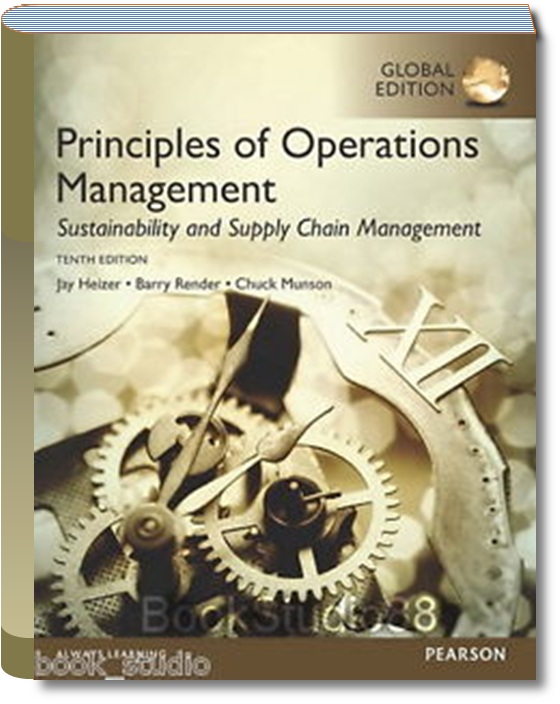
Operations Management (OM) is concerned with the management of resources and activities that produce and deliver goods and services for customers. Efficient and effective operations can provide an organization with major competitive advantages since the ability to respond to customer and market requirements quickly, at a low cost, and with high quality, is vital to attaining profitability and growth through increased market share. As competition becomes fiercer in an increasingly open and global marketplace, a company’s survival and growth become greatly contingent on its ability to run its operations efficiently and to exploit its resources productively.
The course focuses on the basic concepts, issues, and techniques for efficient and effective operations. Special emphasis is placed on process improvement and supply chain management. Topics include operations strategy, product and service design, process design and analysis, capacity planning, lean production systems, materials and inventory management, quality management and six sigma, project management, and supply chain management.
LECTURE MATERIALS
eBook:
PowerPoint 11/e:
- Chapter-01 Operations and Productivity;
- Chapter-02 Global Environment and Operation Strategy;
- Chapter-03 Project Management;
- Chapter-04 Forecasting and Operations Strategy
- Chapter-05 Design of Goods and Services
- Chapter-05s SUPPLEMENT Sustainability
- Chapter-06 Quality Management and International Standard
- Chapter-06s SUPPLEMENT Statistical Process Control
- Chapter-07 Process Strategy
- Chapter-07s SUPPLEMENT Capacity Planning
- Chapter-08 Location Strategies
- Chapter-09 Layout Strategies
- Chapter-10 Human Resources, Job Design and Work Measurement
- Chapter-11 Supply Chain Management
- Chapter-11s Suplement: SCM Analytics
- Chapter-12 Inventory Management
- Chapter-13 Aggregate Planning and S&OP
- Chapter-14 Material Requirement Planning (MRP) and ERP
- Chapter-15 Short-Term Scheduling
- Chapter-16 Just-in-Time, TPS and Lean Operations
- Chapter-17 Maintenance and Reliability
- MODUL-A Decesion Making Tools
- MODUL-B Linear Programming
- MODUL-C Transportation Models
- MODUL-D Waiting-Line Models
- MODUL-E Learning Curves
- MODUL-F Simulation
 Sophora