
The roots of OR can be traced back many decades, when early attempts were made to use a scientific approach in the management of organizations. However, the beginning of the activity called operations research has generally been attributed to the military services early in World War II. Because of the war effort, there was an urgent need to allocate scarce resources to the various military operations and to the activities within each operation in an effective manner. Therefore, the British and then the U.S. military management called upon a large number of scientists to apply a scientific approach to dealing with this and other strategic and tactical problems. In effect, they were asked to do research on (military) operations. These teams of scientists were the first OR teams. By developing effective methods of using the new tool of radar, these teams were instrumental in winning the Air Battle of Britain. Through their research on how to better manage convoy and antisubmarine operations, they also played a major role in winning the Battle of the North Atlantic. Similar efforts assisted the Island Campaign in the Pacific.
At least two other factors that played a key role in the rapid growth of OR during this period can be identified. One was the substantial progress that was made early in improving the techniques of OR. After the war, many of the scientists who had participated on OR teams or who had heard about this work were motivated to pursue research relevant to the field; important advancements in the state of the art resulted. A prime example is the simplex method for solving linear programming problems, developed by George Dantzig in 1947. Many of the standard tools of OR, such as linear programming, dynamic programming, queueing theory, and inventory theory, were relatively well developed before the end of the 1950s. A second factor that gave great impetus to the growth of the field was the onslaught of the computer revolution.A large amount of computation is usually required to deal most effectively with the complex problems typically considered by OR. Doing this by hand would often be out of the question. Therefore, the development of electronic digital computers, with their ability to perform arithmetic calculations millions of times faster than a human being can, was a tremendous boon to OR. A further boost came in the 1980s with the development of increasingly powerful personal computers accompanied by good soft-ware packages for doing OR. This brought the use of OR within the easy reach of much larger numbers of people, and this progress further accelerated in the 1990s and into the 21st century. For example, the widely used spreadsheet package, Microsoft Excel, provides a Solver that will solve a variety of OR problems.Today, literally millions of individuals have ready access to OR software. Consequently, a whole range of computers from mainframes to laptops now are being routinely used to solve OR problems, including some of enormous size.
eBook:
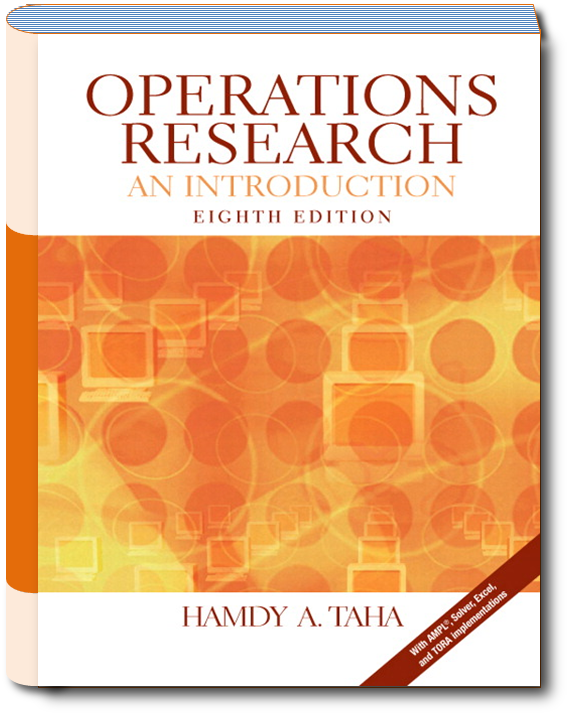
- Hamdy A. Taha. 2007. Operations Research An Introduction
- Bernard W. Taylor III. 2014. Introduction to Management Science, 11th Edition.
- Hillier and Lieberman. 2015. Introduction to Operations Research 10th Edition
Power Point:
- Chapter 01 Introduction
- Chapter 02 Modeling with Linear Programming
- Chapter 03 Simplex Method and Sensitivity Analysis
- Chapter 04 Duality and Post Optimal Analysis
- Chapter 05 Transportation Model and its Variance
- Chapter 06 Network Models
You can also play youtube tutorial videos related to specific chapters, with which you can improve your ability to understand each chapter.
CHAPTER 05
 Sophora